
The AI-Native GTM Stack: A Six-Part Field Manual
I published this series quietly two weeks ago. Enough of you found it on your own that I owe the rest of you a map.

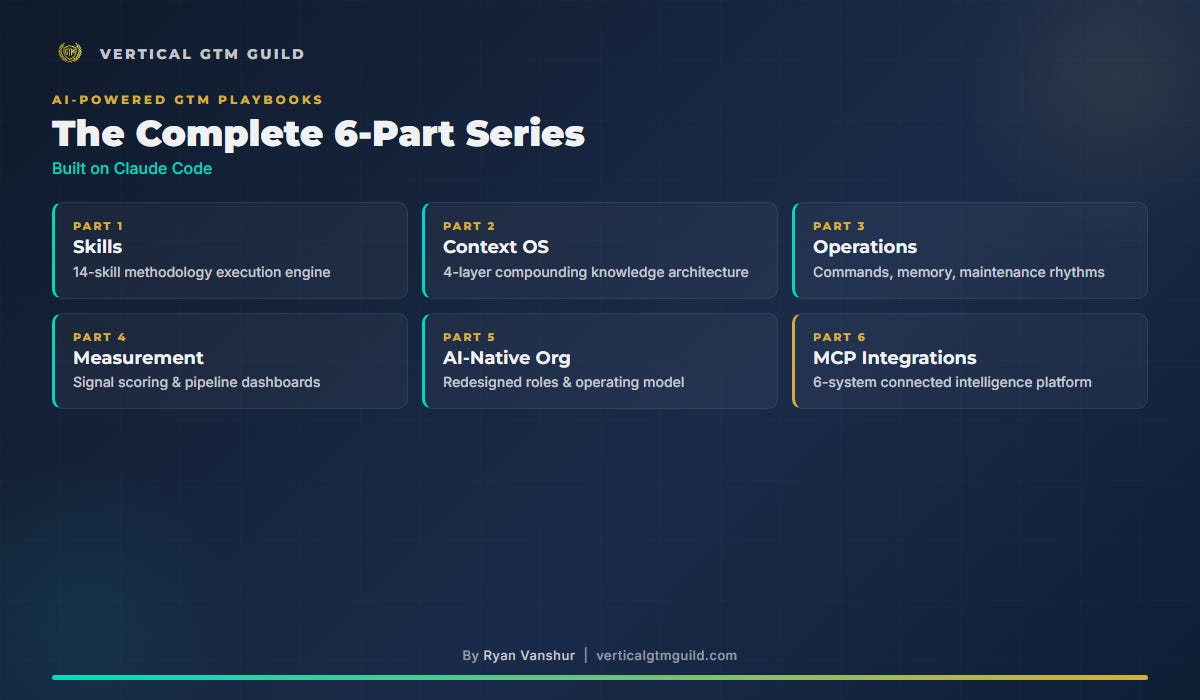
Two weeks ago, six articles went up on this Substack. I didn’t send an email. I didn’t post on LinkedIn. I didn’t tell you they were coming.
They’re the six essays I’ve been writing all year. No clickbait or gimmicky LinkedIn “comment bullshit to get the info.” Every layer of the AI-native GTM operating system I’ve built in production at Handle.com and use across all my consulting work on nine figures of active pipeline, plus the patterns from a decade building GTM in workforce education that eventually sold to private equity.
The quiet drop was deliberate. Most content gets launched before it’s validated. I wanted to see which essays hit without a promotion engine behind them. Enough of you found them that I owe the rest of you a map.
Here it is.
What the series actually is
Most AI content in 2026 stops at tools. “We added a Claude integration.” “Here’s a prompt that wrote my email.” “Our SDRs use an AI dialer.”
Tools are the easy part. The hard part is building the operating system the tools run on.
This series is the operating system. Six layers, each one a prerequisite for the next.
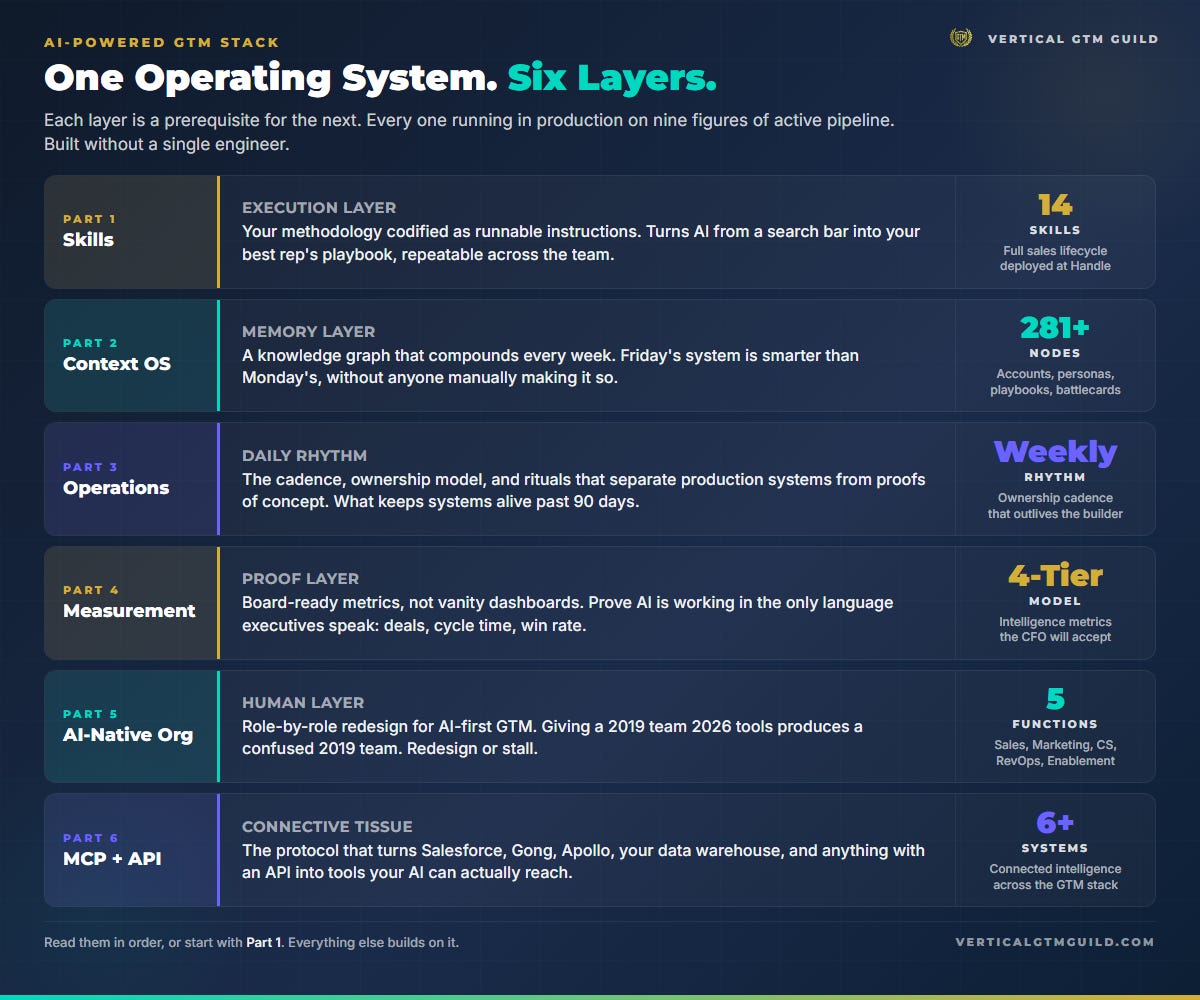
Skills is the execution layer. Context OS is the memory layer. Operations is the daily rhythm that keeps the system alive past quarter three.
Measurement is the proof that turns “AI feels helpful” into a board conversation about win rate. AI-Native Org is the human layer, because you can’t drop AI on a team designed for 2019 and expect the team to redesign itself. MCP Integrations is the connective tissue that stops your AI from being an island.
Every layer is running in production. Most of it was built without a single engineer. The architecture is public at github.com/rvanshur/vertical-gtm-skills. The essays are the narrative version.
Who it’s for
If you run a vertical SaaS GTM function (any of Sales, Marketing, CS, RevOps, or Enablement) and you’ve watched your team use AI like a really fast intern with no onboarding, this series was written for you.
If you’re a founder or CEO of a 50-500 person vertical SaaS company and your board keeps asking where the AI ROI is, this series has the answer. The answer is a system, not a tool.
If you’re one of the operators I keep running into, the ones who nod when I describe 847 enablement assets with 12 getting used, this is the blueprint I wish someone had given me in 2023.
You don’t need to be technical. None of these essays require you to read code. They do require you to think about your GTM function as a system that can be designed, not just a team that can be trained.
The Six Articles, In Order
Part 1: Your Reps Are Using AI Like a Search Bar. Here’s What the Top 1% Are Doing Instead.
The execution layer. Fourteen skills, deployed at Handle across a full sales lifecycle, that turn AI from a really fast intern into your best rep’s playbook. If you read one essay, read this one. Everything else builds on it.
Your Reps Are Using AI Like a Search Bar. Here's What the Top 1% Are Doing Instead.

A practical guide to Claude Code Skills, the system turning vertical SaaS sales teams into methodology-driven machines. Built on Claude Code, Anthropic’s AI-powered development CLI. Includes the 14-skill sales methodology suite, 3 before/after scenarios, and a portable framework you can deploy for any vertical.
Part 2: Your AI Doesn’t Remember Last Quarter. Here’s How to Fix That.
The memory layer. Skills without context are amnesiac. This is how you build a knowledge graph that compounds every week, so the system on Friday is smarter than the system on Monday, without anyone manually deciding to make it so.
Your AI Doesn't Remember Last Quarter. Here's How to Fix That.

A practical guide to building a compounding knowledge system for vertical SaaS GTM teams. This is the infrastructure that turns Claude from a smart assistant into an intelligence engine that gets sharper every week. Includes the 4-layer architecture, step-by-step setup, governance model, and real examples from a system managing 281 knowledge nodes and $…
Part 3: Most AI Systems Die in 90 Days. Here’s the Operations Playbook That Keeps Yours Alive.
The daily rhythm. Everyone can build an AI system. Almost nobody can keep one alive past a quarter. This is the weekly cadence, the ownership model, and the operating rhythms that separate production systems from proofs of concept.
Most AI Systems Die in 90 Days. Here's the Operations Playbook That Keeps Yours Alive.

This is Part 3 of a 6-part series on building an AI-powered GTM operating system with Claude Code.
Part 4: Your AI Dashboard Is a Vanity Metric. Here’s How to Measure What Actually Matters.
The proof layer. If your AI dashboard shows “usage,” you’re measuring the wrong thing. This is the four-tier intelligence model and the board-ready metrics that prove the system is working in the only language executives speak: deals, cycle time, and win rate.
Your AI Dashboard Is a Vanity Metric. Here's How to Measure What Actually Matters.

This is Part 4 of a 6-part series on building an AI-powered GTM operating system with Claude Code.
Part 5: You Gave Your Team AI Tools. You Forgot to Redesign the Team.
The human layer. AI tools don’t fix the org chart. Giving a 2019 team 2026 tools produces a confused 2019 team. This is the role-by-role redesign that moves a GTM organization from AI-enabled to AI-native.
You Gave Your Team AI Tools. You Forgot to Redesign the Team.

This is Part 5 of a 6-part series on building an AI-powered GTM operating system with Claude Code.
Part 6: Your AI Is an Island. Here’s How to Connect It to Everything.
The integration layer. AI that can’t reach your other systems is trapped. This is MCP, the protocol that turns Salesforce, Gong, Apollo, your data warehouse, and anything else with an API into tools your AI can actually use. Wired into all five layers above.
Your AI Is an Island. Here's How to Connect It to Everything.

MCP servers are the integration layer that nobody’s talking about, and the reason my GTM stack actually works. This is the “pull back the curtain” article. Built on Claude Code, Anthropic’s AI-powered development CLI.
What it feels like when it’s running…
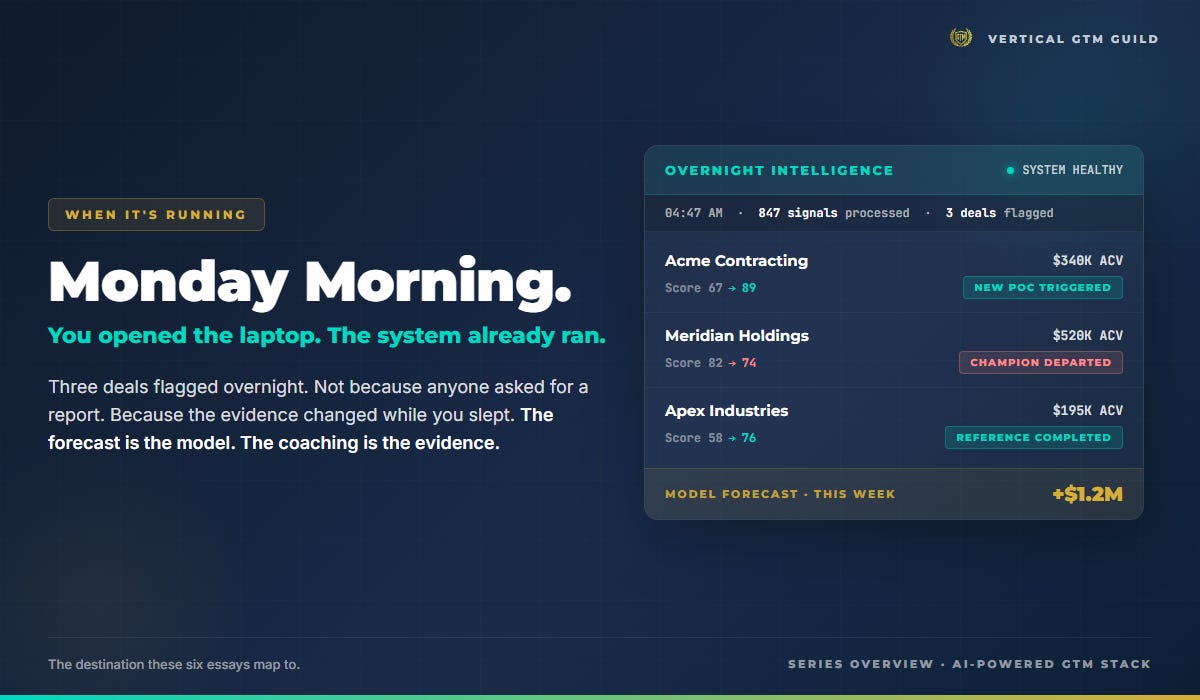
Monday morning. You open your laptop and the pipeline intelligence is already there. Not because a rep updated their opportunity. Not because your CRO asked for a forecast refresh. Because the system ran overnight, pulled new signals, rescored the affected deals, and flagged three that changed status while you were asleep.
The forecast is the model. The coaching is the evidence. The org chart has roles that didn’t exist two years ago and no longer has some that did. Your skills library is version-controlled. Your context layer compounds. Your measurement dashboard shows the board what they actually want to see, which is deals, not demos.
That’s the destination. These six essays are the road map.
Start here
If you’re new to the Guild, start with Part 1 and read it in a single sitting. If it sounds like it was written for you, the next five will feel like the same person kept writing. They were, and he did.
Subscribe if you want the rest of what I’m building. More essays, more frameworks, more of the operator content the horizontal SaaS press never covers.