
The Three Forces
And Why The Vertical SaaS AI Window Is Structurally Different

The Meeting You Stop Having
There is a specific kind of meeting you stop having when AI starts working in your GTM organization. It is the one where the VP of Sales asks the three-rep panel to share what they have been seeing in their territories, and you listen to three different versions of the same thing because nobody has a system for capturing it, so it lives in three different heads.
That meeting was a routine part of my life for ten years at CourseKey. It was a routine part of my life for the first six months at Handle. It has not been a routine part of my life since mid 2025.
The shift was not gradual. There was a window, maybe nine months long, where the components I had been waiting on for years all became available at once. Three forces stacked at the same time. The kind of meeting I am describing started getting rarer immediately. The kind of meeting that replaced it (one where everyone is working from the same captured intelligence and the gaps in the deal pipeline are explicit rather than hidden) became normal in six months.
The window I am describing did not just affect the meeting. It is the underlying mechanism for why vertical SaaS GTM is being reshaped right now, why the reshape happens on a roughly 24-month timeline, and why the operators who recognize what is happening will have a structural advantage that compounds for a decade.
This piece is about that mechanism.
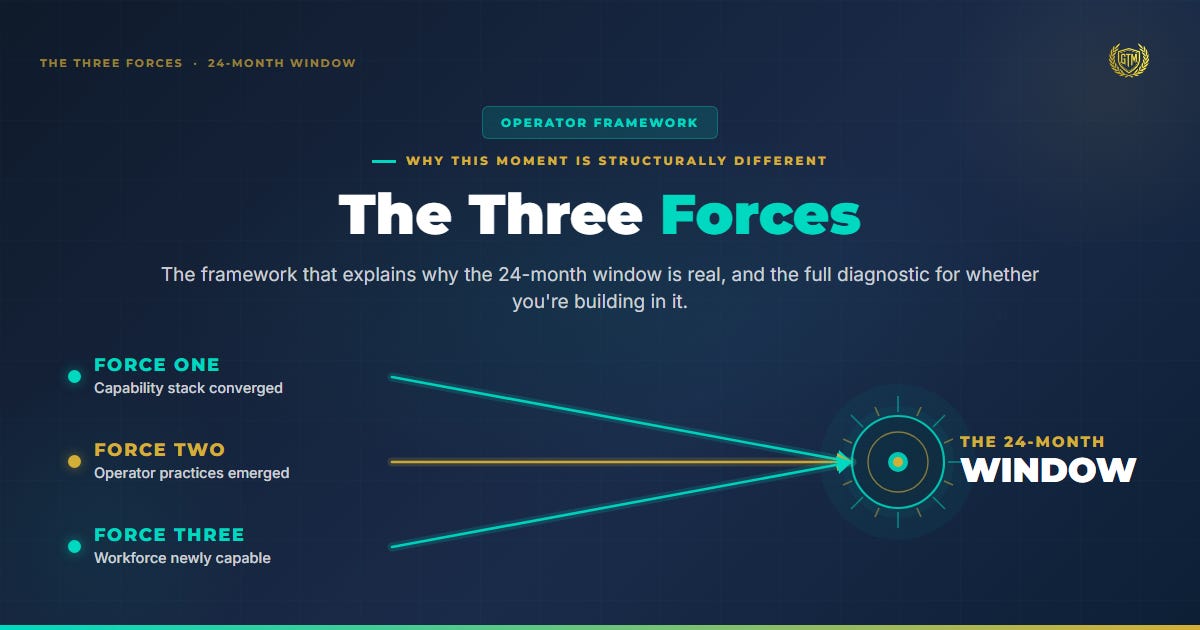
The framework I am going to walk through is what I call the three forces. It is the closest thing I have found to a real explanation for why this moment in vertical SaaS is structurally different from the AI hype cycles we have all seen before. It is also the reason the moat the early operators build will compound for a decade, and why the window for building it is roughly 24 months long.
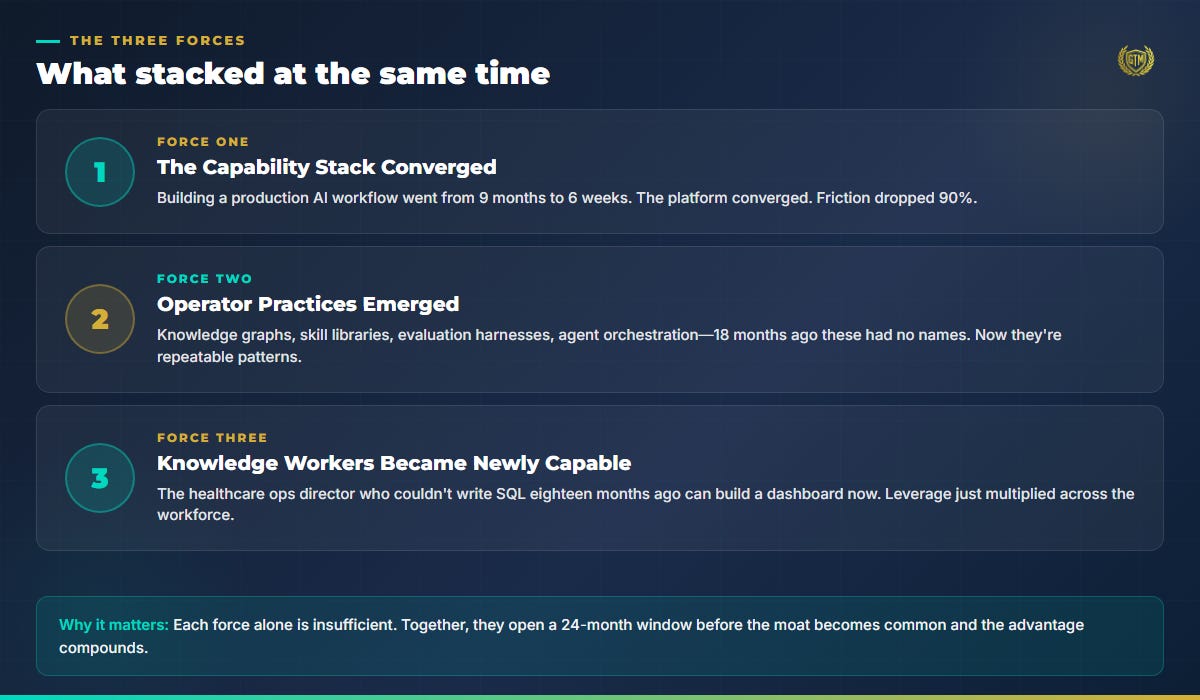
Force One: The Capability Stack Converged
Eighteen months ago, building a production AI workflow inside a vertical SaaS GTM organization required vendor selection across six different categories. A foundation model (with a year-long debate about which one). A vector database (with a different year-long debate). A retrieval-augmented generation framework. An orchestration layer. A prompt management system. An evaluation harness.
Each of those was a separate vendor decision, a separate integration project, and a separate dependency. Most companies stalled at vendor selection. The ones that got through vendor selection spent six to nine months on integration. The ones that finished integration discovered that none of the vendors had been designed to work together, and the system that resulted had so many moving parts that maintenance consumed the team that built it.
That is no longer the situation.
Today, building the equivalent production AI workflow requires Claude with skills, an MCP connection to your knowledge base, and a workflow file. The platform converged. The friction to ship dropped by roughly 90% in twelve months. The integration work that used to take nine months takes six weeks. The maintenance burden that used to consume the team that built the system is now a manageable percentage of one designated operator’s time.
This convergence is not unique to the AI capability stack. The same pattern happened with the global web platform in the early 2000s. The pattern was something like…components that existed individually for years finally fit together into a usable platform. The composition was what changed, not the underlying technology. By the time the platform existed, individual pieces had been around long enough that everyone was used to them. The combination was the new thing.
What was the new thing for the web in 2002 was now the new thing for AI in 2024. Browsers, broadband, scripting, payments, identity, and standardized data interchange had all existed for years before they fit together into the platform that made Amazon, Google, Salesforce, and a generation of SaaS companies possible. By the time the platform existed, the early movers had a roughly five-year head start on everyone else.
The AI capability stack is in the same place right now. The components have existed for several years. They finally fit. The companies that build on the platform now get something like a five-year head start, except compressed into roughly 24 months because the underlying components compose faster.
The work that would have required a small engineering team and a year of integration in 2022 now ships in weeks. I have lived both ends of that drop…building GTM systems the hard way a decade ago at CourseKey, and watching the friction collapse since. That collapse is not a sign of personal heroics. It is a sign that the platform converged. The platform getting easier is the first of the three forces.
Force Two: A New Set of Operator Practices Emerged
The capability stack converging is necessary but not sufficient. The web platform converged in 2002, but the companies that built on it had to figure out new practices to make it valuable. Supply chain orchestration as a discipline. Distributed software development. Customer service that lived across time zones. None of those practices existed in 1998. By 2008, they had certifications.
The same compression is happening to GTM intelligence engineering right now. Practices that did not have names eighteen months ago now have repeatable patterns. They are not yet certified. They are early enough that the operators who can execute them are rare and expensive. But they have names, they have books and conferences and a growing labor market, and they are stabilizing into something a sales ops team can adopt rather than having to invent.
The four practices that matter most for vertical SaaS GTM right now:
Canonical Knowledge Graphs. Structured representations of vertical-specific entities, relationships, and patterns. Not a CRM with custom fields. A purposeful information architecture that an AI system can read and act on. The practice did not have a name in 2024. It has a name now, an implementation pattern, and a small community of practitioners who can build one in just a few months.
Skill Libraries. Codified expert workflows that produce expert-level output regardless of who runs them. Not prompts. Not chatbot personas. Structured instruction sets that take a situation as input and produce work product as output. The discovery prep skill. The deal review skill. The renewal forecast skill. Building these is the work that turns a converged platform into an operating model. The practice did not have a name in 2024. It does now.
Evaluation Harnesses. Test sets that measure AI workflow quality continuously. Not “the team likes it” qualitative feedback. Structured datasets with expected outputs, run against your AI workflows on every change, with quantified pass/fail thresholds. This practice was largely a research-side concept eighteen months ago. It is now a deployment requirement for any serious production AI system.
Agent Orchestration. Coordinating multiple AI systems that work together, hand off context, and handle failures gracefully. Not “we have a chatbot.” A set of cooperating processes that run continuously between human-driven moments, surface signals before they become problems, and update the underlying knowledge graph as they operate. This practice was almost entirely academic eighteen months ago. It is now table stakes for AI-native vertical SaaS.
These four practices, together, are the second force. They are what turn the platform from “useful capability” into “operating model.” Without them, the converged stack is a tool that runs faster. With them, the stack becomes the architecture of the company.
The companies that have operators who execute these practices today have a window of roughly 18 to 24 months before the practices commoditize into packaged products. After that, the practices will be acquirable as software, but the institutional muscle memory of running them will not. The companies that built the muscle in the window will have an 18-month operating lead. The companies that wait for the packaged product will not catch up.
Force Three: Three Billion Knowledge Workers Became Newly Capable
This is the force that gets discussed least and matters most.
In 2005, Thomas Friedman pointed out that roughly three billion people had recently been added to the global economy as workers who could compete on cognitive and operational tasks. The argument was that the global labor force had structurally changed, and the changes would compound for a decade. He was right.
The new three billion are different. They are not new workers entering the global economy. They are existing workers whose ceiling moved.
The healthcare ops director who could not write SQL eighteen months ago can build a working revenue cycle dashboard now. The construction credit manager who used to wait three weeks for a custom report can generate the report in 90 seconds. The specialty insurance underwriter who used to defer to her actuarial team for non-standard quotes can model the quote herself. The legal practice administrator who used to need a developer to build a conflict-check system can build one over a weekend.
These are not better workers. They are workers whose individual leverage just multiplied. The same person, with the same expertise, can now produce work that used to require a different category of employee.
Multiply that across every vertical SaaS market, every operations team, every revenue function. The supply of “people who can build things” just expanded by orders of magnitude. The work that used to require a developer, an analyst, or a specialist can increasingly be done by the domain expert who has the actual context.
This is the third force. It is the one that affects who wins and loses inside your company, regardless of whether you commit to becoming AI-native or not.
The two operators on your team right now who are best positioned for the next five years are not the ones with the most years of experience. They are the ones who have combined deep vertical expertise with the new “individual capability ceiling.” Those operators are also the ones being recruited at $250K and up by companies that figured this out first. Talent gets priced out as the third force compounds.
I have a 24-year-old daughter and her generation will enter a labor market where the basic capability ceiling is fundamentally different from the one I entered in 2003. Every entry-level knowledge worker in 2027 will have access to capabilities that required a small team in 2023. The implications are still unfolding. The thing to know now is that the workforce in your own company, the operators you already have, just got more capable than you realize. Whether you build the systems that take advantage of that, or whether your competitor does, is the choice on the table.
Why This Window Is Structurally Different
Every prior AI cycle had hype that exceeded the substance. The 1980s expert systems cycle. The 1990s neural networks cycle. The 2010s deep learning cycle. Each of them produced real technology and real applications and also produced an enormous amount of premature commercial enthusiasm that did not pan out.
This cycle is different in three specific ways, and the three differences map to the three forces.
It is different because the capability stack converged into something a non-engineer can use. Prior AI cycles produced technology that required specialists to deploy. The current stack does not. A vertical SaaS GTM lead can stand up production workflows that would have required a small team and a year of integration in 2022. That accessibility is not a marketing claim. It is the reason a single operator can run a stack of production AI workflows that simply could not have existed three years ago. The deployment threshold has dropped to a level that lets the application happen at scale.
It is different because the operator practices stabilized. Prior AI cycles produced technology that nobody knew how to operate. Companies bought expert systems in 1988 and did not know what to do with them. They bought neural networks in 1995 and did not know what to do with them. They bought deep learning platforms in 2017 and mostly did not know what to do with them. The current cycle produced the practices alongside the technology. The companies that adopt now have a playbook to adopt against. The playbook is still rough. It is also real.
It is different because the workforce can run it. Prior AI cycles depended on specialists to bridge between the technology and the business. The current cycle does not. The domain expert can run the system themselves, with skills and a knowledge graph and an orchestration layer that lets them put their own expertise into the workflow. The dependence on specialists is dropping fast. The bottleneck on adoption is moving from “can we hire enough experts” to “can we get our own experts to redesign their workflows.”
The three differences, together, are why the 24-month window is real. Each one is necessary. None is sufficient by itself.
When all three are present (the platform, the practices, and the capable workforce), companies that commit to AI-native architecture compound a moat that lasts a decade. When any one is missing, the moat does not form. We have spent thirty years waiting for all three to be present in the same window. They are present now, in vertical SaaS specifically, for the next 24 months.
The window will close. The three forces will not stay novel. Once they are common, the companies that built into the window will have the advantage. The companies that watched will have to play catch-up against an architecture that compounded for two years before they started.
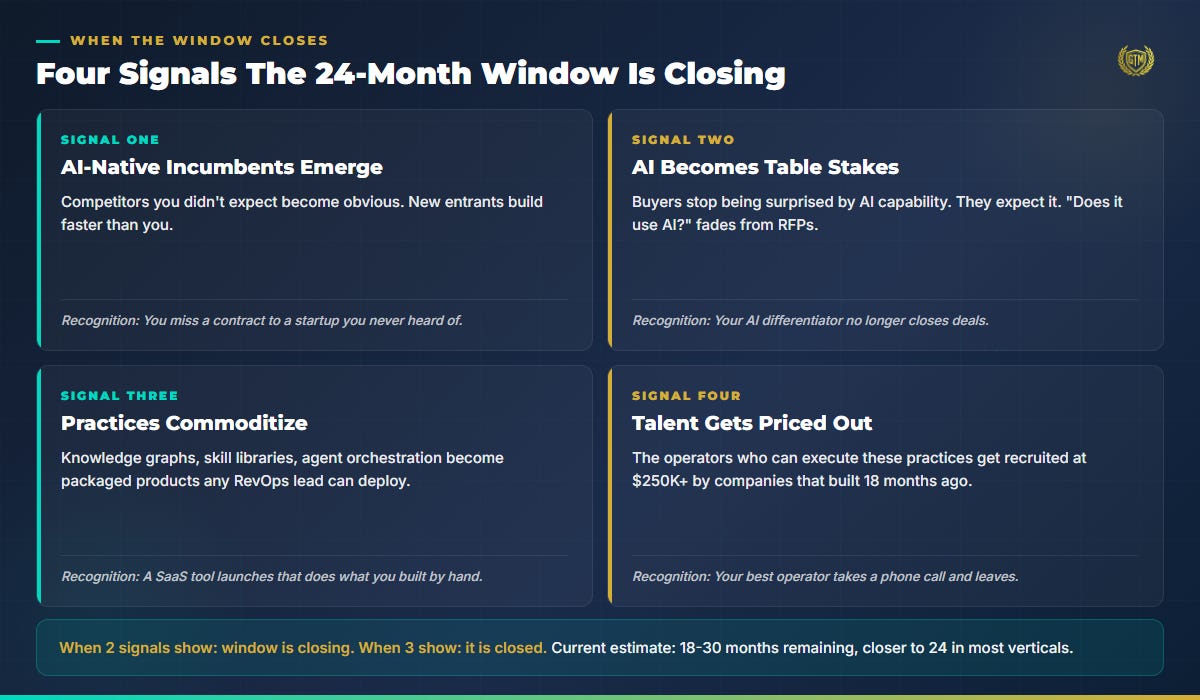
Four signals tell you the window is closing. Each one has a specific recognition cue inside vertical SaaS GTM:
AI-native vertical incumbents emerge as competitors you did not expect.
Buyers stop being surprised by AI capability and start treating it as table stakes.
The operator practices commoditize into packaged products that any RevOps lead can deploy.
The talent that can execute the practices gets priced out beyond your comp band.
When two of these signals show up in your market, the window is closing. When three show up, it is closed.
My estimate, calibrated to the verticals I operate in directly…the window has somewhere between 18 and 30 months left. Closer to 24 in most verticals. Software-adjacent verticals (legal tech, healthcare RCM, field service software) will close faster. More conservative verticals (specialty insurance, professional services, regulated industries) will close more slowly. The compression matters either way.
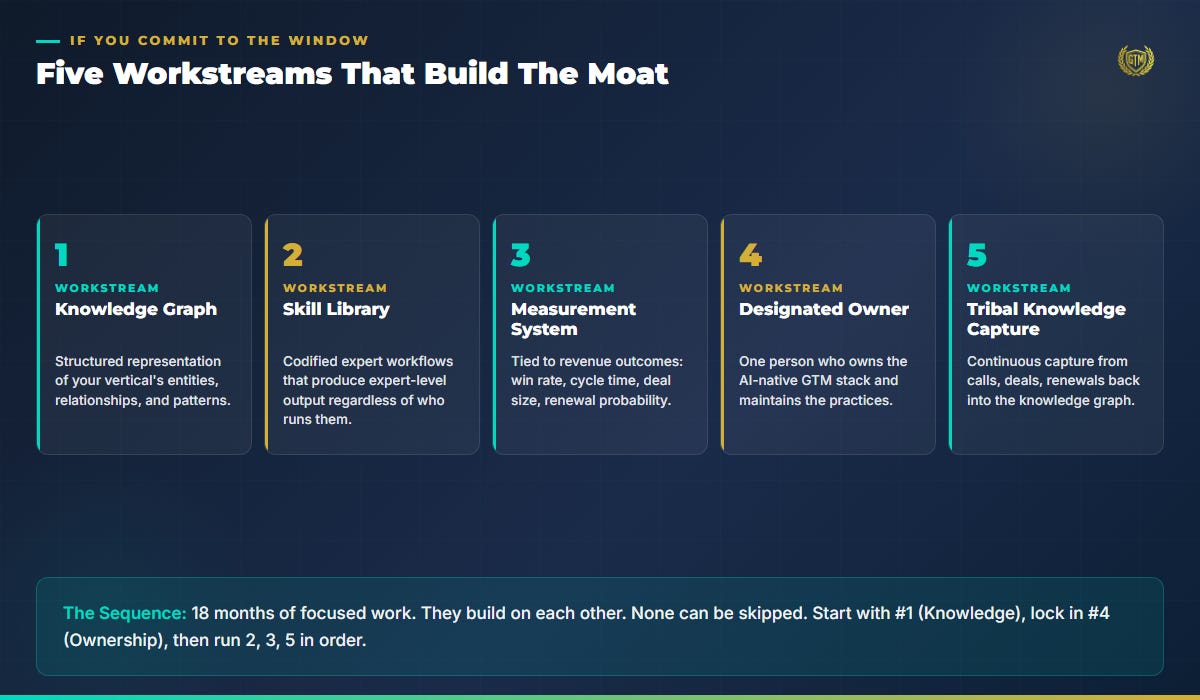
If you commit to building AI-native vertical SaaS over the next 18 months, five workstreams define the architecture.
A canonical knowledge graph for your vertical. Structured representation of the entities, relationships, and patterns your best operators use. The raw material for everything else.
A skill library for your highest-leverage workflows. Codified expert workflows that produce expert-level output regardless of who runs them.
A measurement system tied to revenue outcomes. Win rate, cycle time, deal size, renewal probability. Not adoption rate.
A designated owner. One person who owns the AI-native GTM stack and the practices that maintain it. Title varies. Function does not.
A real-time tribal knowledge capture practice. Continuous capture from calls, deal reviews, renewals, and workflow outcomes back into the knowledge graph.
Each of these is substantial enough to be its own subject. The five workstreams together are 18 months of focused work for a designated operator with the right scope. They can be sequenced. They cannot be skipped. Each one produces less value alone than it produces in combination. The companies that build all five compound the moat. The companies that build two or three get partial benefit. The companies that build zero are AI-enhanced.
The Window Test
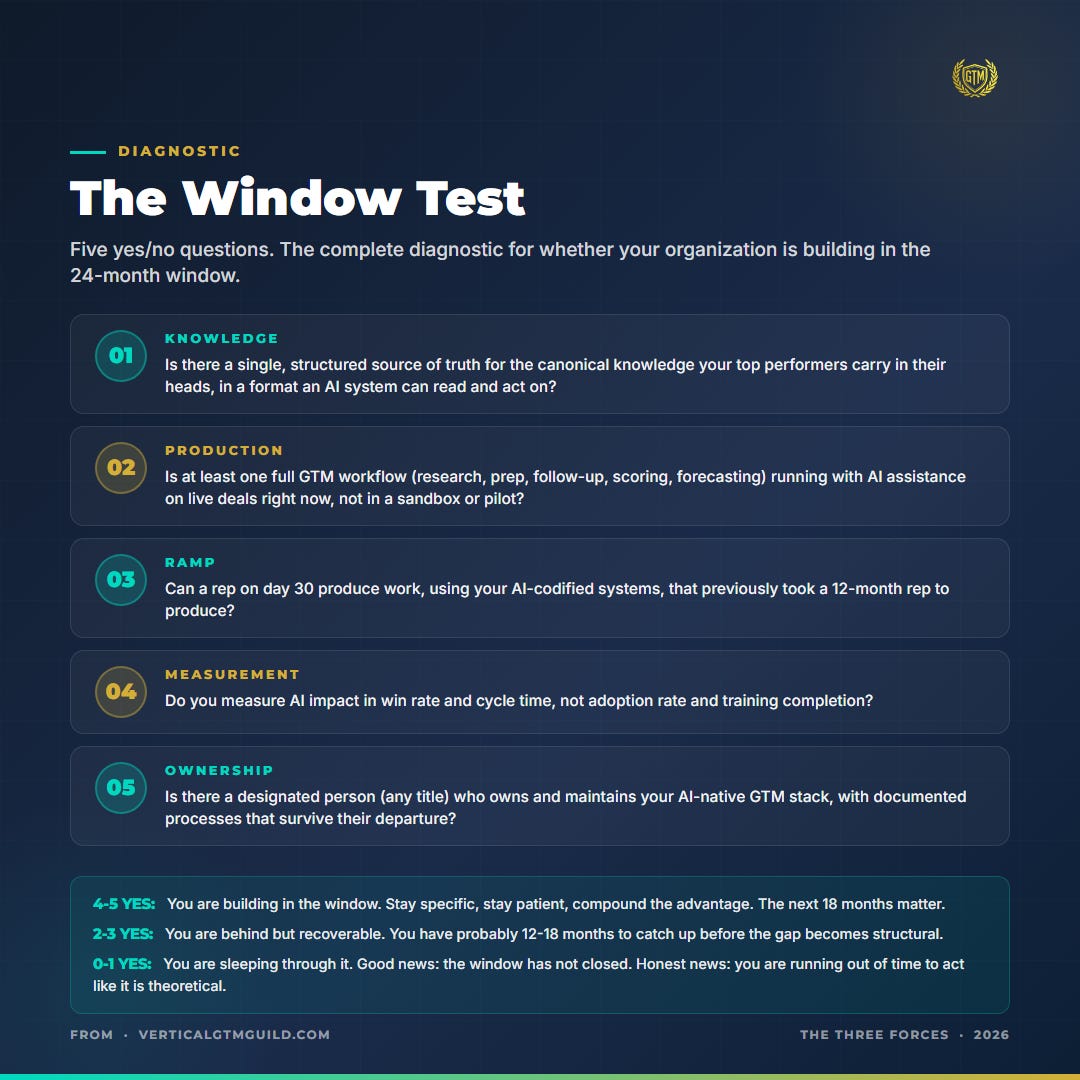
Five yes/no questions. The complete diagnostic for whether your organization is building in the window.
Knowledge: Is there a single, structured source of truth for the canonical knowledge your top performers carry in their heads, in a format an AI system can read and act on?
Production: Is at least one full GTM workflow (research, prep, follow-up, scoring, forecasting) running with AI assistance on live deals right now, not in a sandbox or a pilot?
Ramp: Can a rep on day 30 produce work, using your AI-codified systems, that previously took a 12-month rep to produce?
Measurement: Do you measure AI impact in win rate and cycle time, not adoption rate and training completion?
Ownership: Is there a designated person (any title) who owns and maintains your AI-native GTM stack, with documented processes that survive their departure?
4 to 5 yes: You are building in the window. Stay specific, stay patient, compound the advantage. The next 18 months matter more than the next 18 weeks.
2 to 3 yes: You are behind but recoverable. You have probably 12 to 18 months to catch up before the gap becomes structural. The two questions you scored “no” on tell you exactly where to focus.
0 to 1 yes: You are sleeping through it. The good news is the window has not closed. The honest news is you are running out of time to act like it is theoretical.
Print this. Run it every quarter. The score should move up. If it does not, that is a signal too.
What Does Not Change
The honesty section before we close.
The three forces, the four signals, the five workstreams, the full Window Test…none of this replaces the foundation that has always made vertical SaaS work. Relationships still close deals. Domain credibility still gets vendors in the room. Vertical depth still moves you from “vendor” to “partner.” The AI-native architecture sits on top of those constants, not in place of them.
The healthcare-RCM rep who knows every billing director in her region by name is not displaced by AI. She is displaced by a rep in a different region who has the same depth and an AI-native system on top of it. The depth is the foundation. The AI-native architecture is the leverage.
Sales methodology still matters. The skill library has to be structured around something. The methodology gives it that structure.
Customer success still requires people. AI does not sit in the room when a customer’s head of operations needs to hear, from a human, why the number moved. It might prepare you better for that conversation. The conversation is still the conversation.
Reps still need to talk to people. Field service operators still need to know their territory. The agricultural lending officer who knows the rotational practices of every co-op in the southern half of the state is the asset; AI-native architecture is the multiplier.
What changes is whether you compound the leverage on top of the foundation, or whether you bolt AI features onto a 2023 operating model and call it done.
The Monday Inside The Window
A vertical SaaS company that has spent eighteen months committing to this looks different on a Monday morning. Not in a dramatic, science-fiction way. In a quietly cumulative way that is hard to notice from the outside until you look at the metrics over a 24-month period.
The captured knowledge graph is the foundation. Everyone in the GTM organization works from the same intelligence. The senior account manager’s tribal knowledge is in the graph and is consulted by every workflow. When she gets pulled into a strategic project, the deals she would have run go to other AEs running against the same intelligence she would have applied. The deals close at roughly the same rate.
The AI-native architecture is the operating model. The company is no longer playing the AI-enhanced game. The product, the team, the process, and the metrics have all been rebuilt around what AI makes possible. The new entrants in the vertical look interesting. They do not look threatening, because the company has a depth they cannot acquire fast enough.
The rebuilt workflows are the work itself. The credit analyst is investigating the customers whose scores moved over the weekend. The healthcare RCM team is reviewing pre-flagged claims before submission. The legal practice administrator is approving the system’s intake recommendations. The output is meaningfully different from what the same team produced in 2023, with the same number of people and the same number of hours in the day.
The three forces are the substrate underneath all of it. The platform converged. The practices stabilized. The operators became newly capable. The company is operating in a window that opened recently and will close within roughly 24 months, and the company is using the window to compound something that will last a decade.
The picture is not exotic. It is just a company that has committed to a specific kind of architecture during a specific window, and is compounding the advantage on a roughly weekly basis.
The vertical SaaS company across the street is having a different Monday. Their reps are pasting prospect names into a chatbot and getting back prep that sounds professional and says nothing. Their pipeline meeting is the same defensive performance it has been for two years. Their best operator just took a recruiter call from an enterprise company that figured out the AI-native architecture two years ago.
Which Monday you wake up to is still, today, a choice. The window is open. It will not stay open. Most of you are sleeping through it.
You do not have to be.
The systems described here are real and in production, not concept decks or proofs of concept. They were built and refined across two very different verticals: a decade in vocational education, and the work since in construction fintech. Different verticals, same kind of moat.
If you are in the middle of a partial build, the Window Test above will tell you where to focus next. If you have not started, the Window Test will tell you what the first commitment looks like.
Where do you, personally, fit in your company’s AI-native build? Are you the designated owner? Are you the executive sponsor? Are you the operator whose tribal knowledge is the raw material? Are you a skeptic who has not been convinced?
Ryan Vanshur is the founder of the Vertical GTM Guild and Head of GTM Intelligence and AI Solutions at Handle. He co-founded CourseKey and scaled it from a $1,200 minimum viable product through a private equity exit over a decade in vocational education, building and rebuilding its GTM operating model along the way. He writes about AI-native go-to-market for vertical SaaS operators. The Vertical GTM Guild is the community of operators building AI-native GTM in vertical SaaS markets, from the inside.