
AI-Native or AI-Enhanced
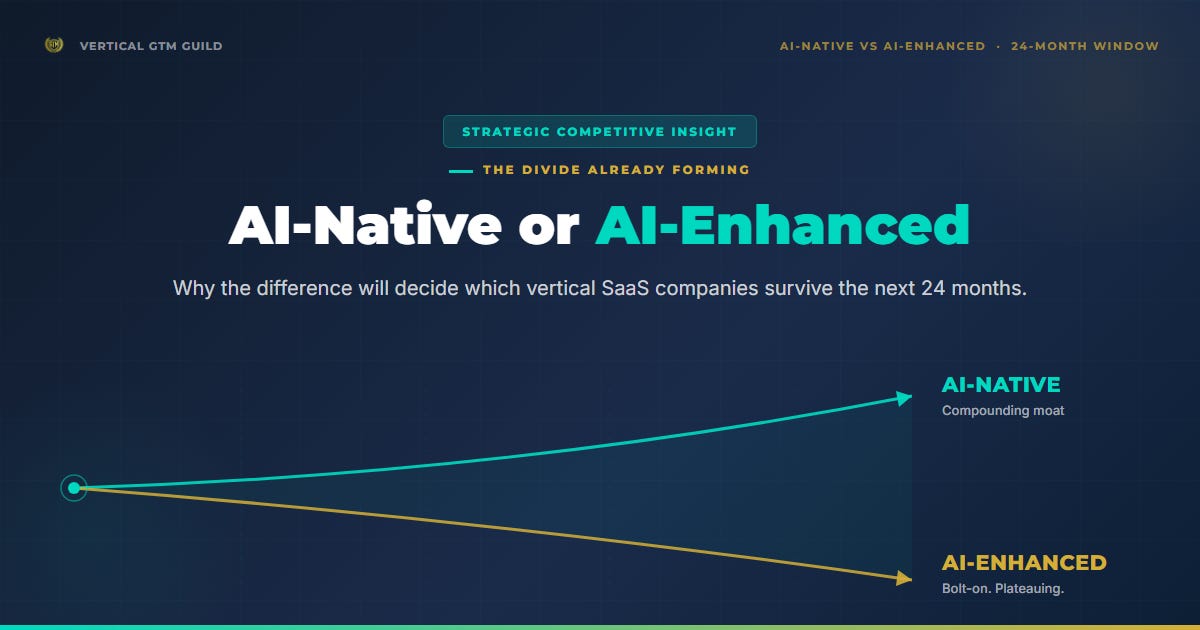
A divide is forming in vertical SaaS, on a 24-month timeline. One side gets the next decade. The other side becomes the case study.

Yahoo Photos Had A Mobile Strategy
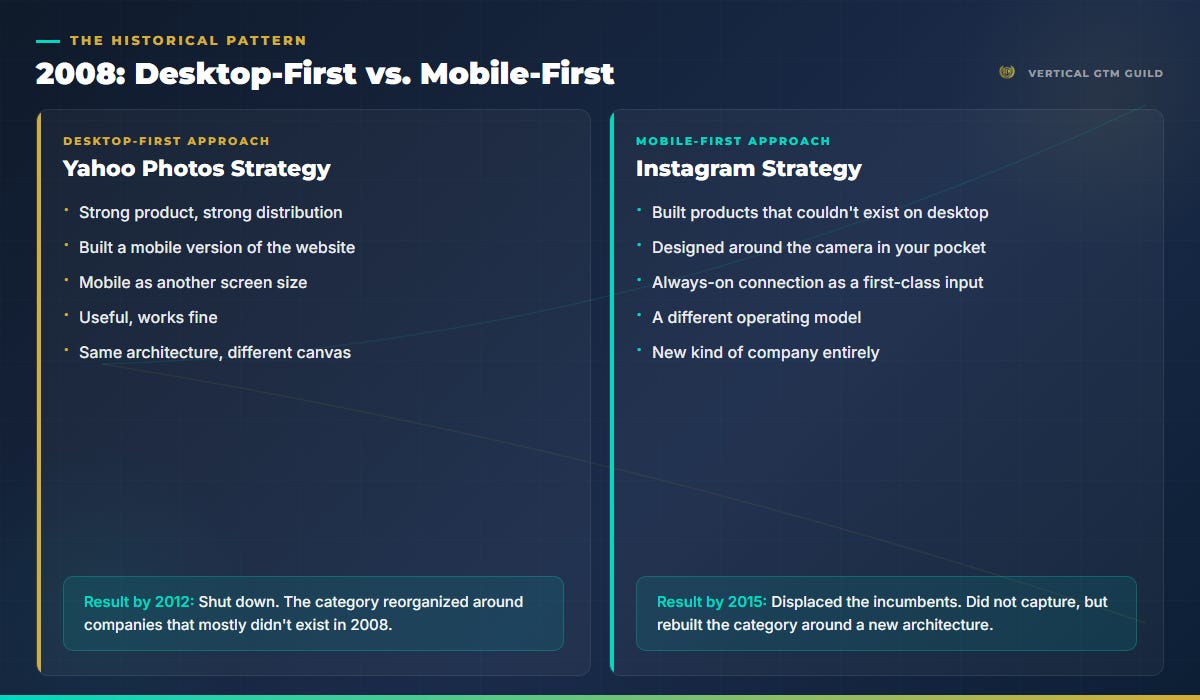
In 2008, almost every B2C company in the world had a mobile strategy. The strategy was “make a mobile version of our website.” It made sense. The desktop product worked. The mobile version should also work. Mobile was just another screen size.
A few founders saw it differently. They did not build mobile versions of desktop products. They built products that could only exist on mobile. Instagram could not exist before the camera in your pocket. WhatsApp could not exist before the always-on data connection. Uber could not exist before GPS in every hand.
By 2015, the AI-enhanced version of the Yahoo Photos strategy had been flattened by the AI-native version of the Instagram strategy. Yahoo Photos had a mobile site. It had distribution. It had a brand. By 2012, it was shut down. By 2015, the entire category had been reorganized by companies that mostly did not exist when the question was asked.
It is about to happen again. This time in vertical SaaS. This time on a roughly 24-month timeline.
The mechanism is the same as the mobile-first transition. A few companies will build around what the new platform makes possible. Most will build the old company with new features bolted on. The ones who rebuild will win the next decade. The ones who bolt-on will look fine for a while and then look obsolete fast. The rest of this piece is about what each side actually looks like in vertical SaaS, why the divide will be decisive within 24 months, and why vertical operators have a structural advantage the mobile-late B2C companies did not.
What “AI-Enhanced” Looks Like Right Now
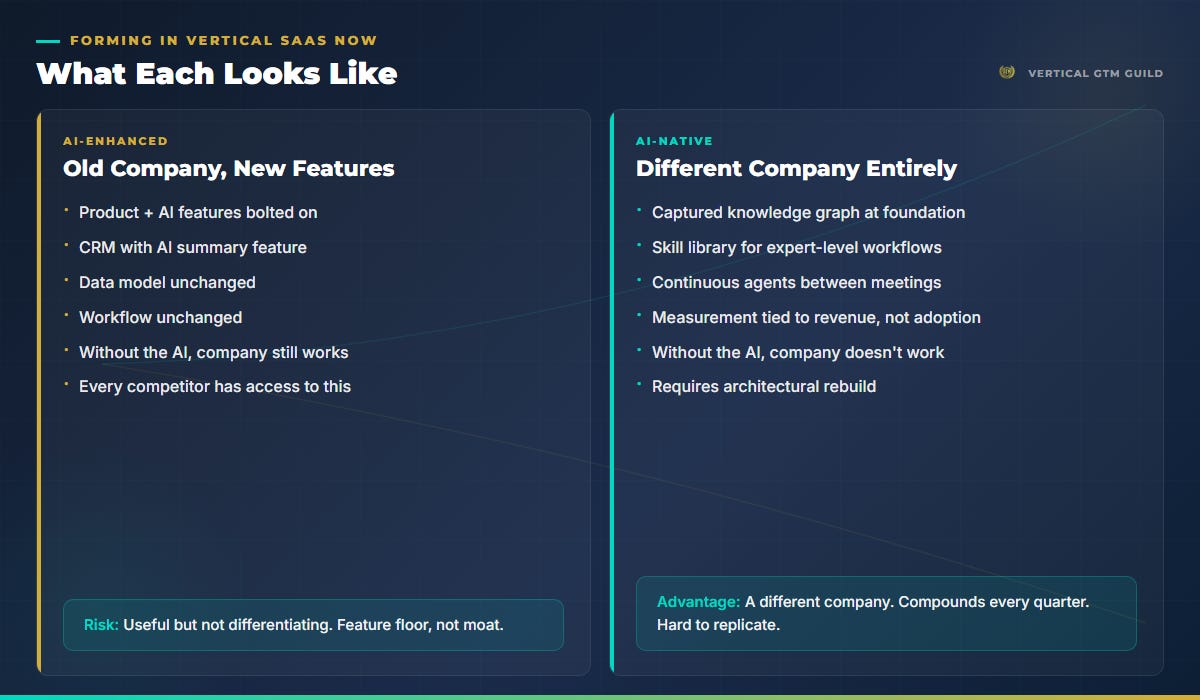
Most vertical SaaS companies right now are AI-enhanced. The product is the same product you had in 2023, with AI features bolted on. The CRM with an AI summary feature. The customer support tool with an AI draft button. The forecasting module that now does “AI-powered” predictions on top of the same data pipeline you had before.
These features are useful. They make existing workflows roughly 20-30% faster. They produce a marketing story that lets your AEs check the “yes, we have AI” box on enterprise security review.
They do not change the architecture of the company.
The data model is the same data model. The CRM workflow is the same workflow. The way reps prepare for calls, run meetings, and write follow-ups is the same way. The product looks better on the demo screen. The underlying system that produces value is architecturally identical to the pre-AI product.
If you took the AI features out tomorrow, the company would still work. That is the definition of AI-enhanced.
The risk is not that AI-enhanced doesn’t work. It works fine. The risk is that AI-enhanced is the same architecture every other competitor in your vertical has access to. Salesforce will ship the same summary feature. HubSpot will ship the same forecast feature. Your own product team will ship a version. So will the three competitors that have been quiet for two years.
AI-enhanced is not a differentiator. It is a feature floor. By 2027, every vertical SaaS product will have it, your buyers will assume it, and the same security review checkbox that asked about it in 2025 will not move a meeting forward in 2027.
What “AI-Native” Looks Like
The AI-native version of a vertical SaaS company is a different shape.
A captured knowledge graph (a structured representation of the entities, relationships, and patterns that define your vertical) sits at the foundation of every workflow, not bolted to the side of one.
The skill library, which is codified expert workflows that produce expert-level output regardless of who runs them, is what new reps learn, what veterans use, and what the AI agents enforce.
The agents are not chatbots. They are continuous processes that run between meetings, surface signals before reps ask, and update the knowledge graph as deals progress.
The measurement system ties AI usage to revenue outcomes, not adoption rates.
The forecast comes from a model that has read every closed-won and closed-lost call in the company’s history, not from a manager’s gut feel plus a percentage adjustment.
The renewal pipeline gets refreshed continuously because the signals that predict churn arrive continuously, not because someone scheduled a quarterly review.
Day 30 reps perform at a level that previously required twelve months of tenure.
Pipeline reviews take 20 minutes because the gaps in deals are explicit before the meeting starts.
Strategic whale accounts have real-time visibility instead of the eternal request from leadership for it.
If you took the AI features out of this company tomorrow, the company would not work. The AI is not a feature. It is the architecture.
This is what AI-native means. The product, the team, the process, the metrics, and the operating cadence have all been rebuilt around what AI makes possible. The output is not a faster version of the old company. It is a different company.
I have spent years building toward roughly that company, most recently in construction fintech and, before that, across a decade in vocational education. It is not theoretical. It is also not finished. The work compounds. Every quarter the system is more capable than it was the quarter before. That compounding is the point.
The Four Signals That Tell You The Divide Is Decisive
The mobile-first transition took about seven years to fully reorganize the consumer tech landscape. The AI-native transition is compressing into roughly three years. The compression matters because it gives operators less reaction time. The mobile-late companies had time to fail loudly first. The AI-late companies may not get that warning.
There are four signals that tell you the window is closing. Each one has a specific recognition cue inside vertical SaaS GTM. When two of these show up in your market, the window is closing fast. When three show up, it is closed.
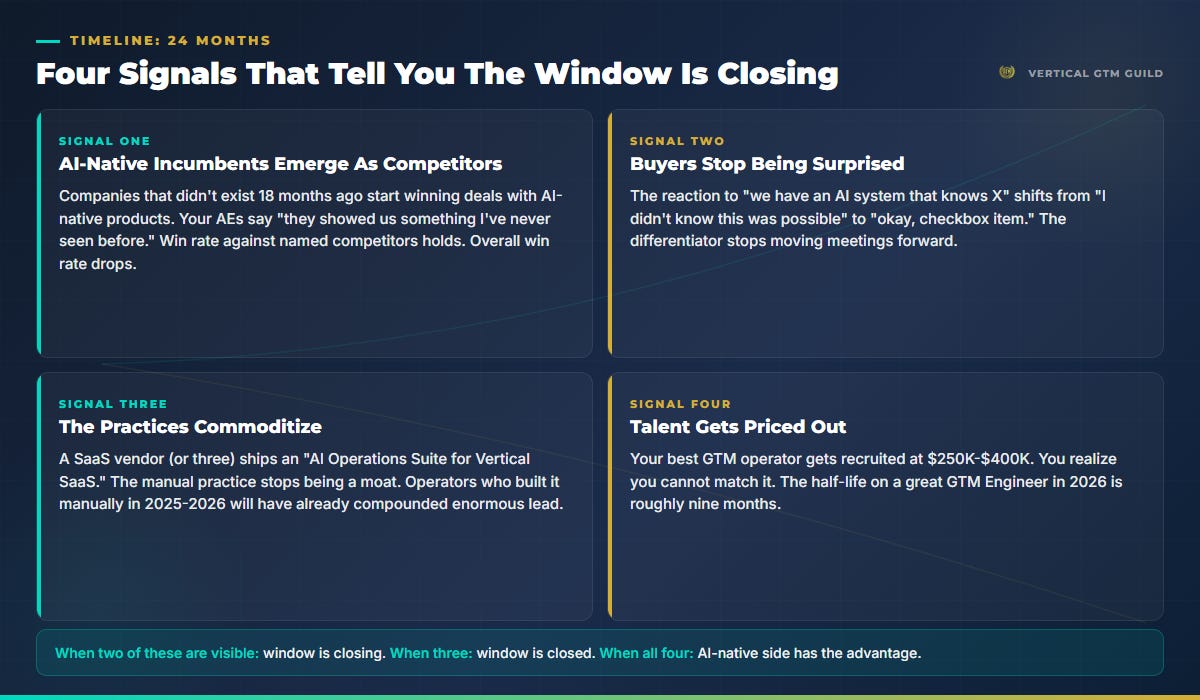
Signal 1: AI-Native Vertical Incumbents Emerge as Actual Competitors.
Right now, almost every vertical SaaS company is some version of “AI-enhanced legacy product.” Your competitors look like you. The roadmap is the old roadmap with AI features.
This changes when companies that did not exist 18 months ago start winning deals in your vertical with a product that was AI-native from day one. They show up first in software-adjacent verticals: legal tech (Eve, Harvey, others), healthcare RCM (Hippocratic, Notable, others), field service management (multiple startups in the last two years). They will show up in your vertical, on a timeline that depends roughly on how technically demanding your buyer is.
Recognition Cue:
You start losing deals not to the incumbent competitor you have always lost to, but to a company that did not exist eighteen months ago.
Your AEs come back from QBRs saying “they showed us something I have never seen before.”
Your win rate against named competitors holds.
Your overall win rate drops, and you cannot quite say to whom.
Signal 2: Buyers Stop Being Surprised by AI Capability.
This is the signal that closes the differentiation window faster than any other. Today, when your AE shows a prospect a working AI capability grounded in your vertical knowledge, the prospect’s reaction is some version of “I did not know this was possible yet.” That reaction is the differentiator. It is what moves the meeting from “interesting demo” to “we need to figure out a procurement path.”
When the reaction stops, the differentiator stops.
Recognition Cue:
Your AEs report that the AI portion of the demo no longer moves the meeting forward.
The procurement teams now ask about it as a checkbox item in security review rather than as a competitive question.
The reaction to “we have an AI system that knows X about your industry” is “okay, what else?”
Expect this in software-adjacent verticals by late 2026. In more conservative verticals (specialty insurance, professional services, regulated industries), 2027 or 2028. Sooner than you think regardless.
Signal 3: The Practices Commoditize.
Right now, building a canonical vertical knowledge graph, designing a skill library, and running an evaluation harness for AI workflows are practices that require a specific kind of operator. They are not standard parts of the RevOps stack yet. Most vertical SaaS companies cannot execute these practices internally because the operators do not exist on their teams.
That window stays open until someone packages the practices into a product that any sales ops manager can deploy in a week. Some of these products already exist in early form. Most are not very good. When they become very good, the practice stops being a moat.
Recognition Cue:
A SaaS vendor (or three) announces an “AI Operations Suite for Vertical SaaS” or “AI Sales Stack” or “AI-Native RevOps Platform.”
The first wave of these is hitting market right now and is mostly not very good. The second wave will be better. The third wave will be table stakes.
When the third wave is shipping, the operators who built the practice manually in 2025 and 2026 will have already compounded their lead by an enormous amount. The companies starting in 2028 will not catch up.
Signal 4: The Talent Gets Priced Out.
This is the most concrete signal. The operators who can codify vertical knowledge into production AI systems are currently underpaid for what they do. That ends.
Enterprise companies are already paying $250K and up for AI-fluent GTM operators. The job listings have specific titles now: GTM Engineer, AI Operations Lead, Sales Intelligence Director, Head of Revenue Systems. The comp for these roles doubled year-over-year in 2025 and is on track to do something similar in 2026. The talent pool that built CourseKey’s RevOps stack from scratch a decade ago could be hired for $130K to $180K. The same person, doing comparable work in 2026, is at $250K to $400K.
Recognition Cue:
Your best GTM operator gets recruited by an enterprise company or starts a consultancy.
You learn what their offer was. You realize you cannot match it inside your current comp band.
You also realize you cannot replace them within your budget.
I am watching this happen in real time across the operators in my network. The half-life on a great GTM Engineer in 2026 is roughly nine months in their current role.
When two of these four signals are visible in your market, the window is closing. When three are visible, it is closed. By the time all four are visible, the companies that built AI-native have the advantage and the companies that didn’t have the press release announcing their next strategic pivot.
Why You Have An Advantage The Mobile-Late Companies Did Not
Here is the part that gets lost in most “AI-native vs. AI-enhanced” framing. It is also the reason this article exists.
The mobile-first companies that displaced their AI-enhanced predecessors were almost all new entrants. Instagram was a startup. WhatsApp was a startup. Uber was a startup. They displaced incumbents because the incumbents could not rebuild their architecture from a position of size.
AI-native vertical SaaS does not have to be a new entrant. You can become AI-native from your existing position. You start now. You commit. You assign an owner. You take 18 months and you build.
The reason you can is what you already own. You have something the new entrants do not. The captured vertical knowledge. The operator relationships. The decade of accumulated pattern recognition that lives in your senior people’s heads. The new entrants have AI engineering muscle and a clean architectural canvas. You have a deeper supply of the actual raw material that AI needs to be useful in your vertical.
This is the structural advantage. You can become AI-native and keep your vertical depth. The new entrants will have to acquire the depth, and they will not acquire it fast enough.
This is the part where vertical SaaS gets to write a different story than B2C tech wrote in the mobile transition. Yahoo Photos could not rebuild itself around the camera in your pocket. You can rebuild yourself around AI-native architecture. The only thing required is that you start, and that you commit to two specific workstreams that are mostly invisible from the outside.
The Two Workstreams That Define AI-Native
Five workstreams define an AI-native vertical SaaS company. Two of them are the difference between “we shipped an AI feature” and “we built an AI-native operating model.” Those are the two I want to walk through here.
Workstream 2: A Skill Library for the Highest-Leverage Workflows.
A skill is a codified expert workflow. Not a prompt template. Not a chatbot persona. A structured instruction set that produces expert-level output regardless of who runs it. The input is the situation. The output is the work product.
Discovery prep. Deal review. Renewal forecasting. RFP response. Outbound research. QBR prep. Each of these is a workflow where the gap between your top performer’s output and your average performer’s output is wide. That gap is where codified skills produce the most value.
The test for a skill is not whether it works in a demo. The test is whether a 30-day rep can use it to produce work that previously took a 12-month rep. If yes, the skill is real. If no, it is a prompt template.
I have built a stack of these in production. They cover account research, pipeline analysis, deal coaching, renewal forecasting, and several internal workflows. They run on top of the captured knowledge graph and an evaluation harness that catches degradations early. They are not features. They are how the company actually operates.
A vertical SaaS company without a skill library is running on the same operating model it had in 2023, with some AI features added to the surface. A vertical SaaS company with a skill library is running on a different operating model that gets more capable every quarter.
Below is a deep dive into skills from the AI-Native GTM Series.

Workstream 4: A Designated Owner.
The hardest part of becoming AI-native is not the technology. It is the org chart.
There needs to be a single person who owns and maintains the AI-native GTM stack. The captured knowledge graph. The skill library. The evaluation harness. The measurement system. The integration with the rest of the GTM tech stack. This person has a different title in every company. GTM Engineer is the most common. RevOps Lead. Sales Intelligence Manager. Head of Revenue Systems. The title does not matter. The function does.
Without one person owning this, you do not have a stack. You have experiments. Experiments do not compound. They drift, they fragment, they get replaced when their internal champion moves to a different role.
I was that person at CourseKey for a different generation of the same problem. We were building the RevOps tech stack during the cloud transition in vocational education. The function was new. The title kept changing. The work was the same: own the system that produces leverage for the GTM team. The companies that designated someone for that role in 2017 had a coherent RevOps function by 2020. The companies that distributed the responsibility across three departments still do not have one.
The same pattern is repeating now, in faster compression. The companies that designate an owner for the AI-native GTM stack in 2026 will have a coherent function by 2028. The companies that distribute the responsibility across three departments will be sourcing the function externally by 2029, at consultant rates that will make them wish they had hired internally when the talent was still hireable.
The five workstreams together are the architecture. The two above are the ones that decide whether you sit on the AI-native or AI-enhanced side of the divide. The other three are each substantial enough to deserve their own treatment.
What Doesn’t Change
The honesty section before we close.
Becoming AI-native does not replace the things that have always made vertical SaaS work. Relationships still close deals. Domain credibility still gets you in the room. Vertical depth still moves you from “vendor” to “partner.” The flattening is not “AI replaces all of that.” The flattening is “the companies that have all of that, plus AI-native architecture, run circles around the companies that have all of that but stayed AI-enhanced.”
The field-service AE who knows every facilities manager in her metro by first name is not displaced by AI. She is displaced by an AE in the next metro over who has the same depth and an AI-native system on top of it. The depth is the foundation. AI-native is the leverage.
Sales methodology still matters. The skill library has to be structured around a methodology that fits your vertical. Without a methodology, the skill library is a collection of useful prompts that does not aggregate into a coherent operating model.
Customer success still requires people. AI does not have the call where you talk an anxious account owner off the ledge after a bad month. It might prepare you better for it. The call is still the call.
Reps still need to talk to people. The territory still has to be walked. Buyers still need to feel that the vendor across the table has been in their world longer than a quarter.
What changes is which side of the divide you operate from. AI-enhanced makes the same company faster. AI-native makes a different company entirely.
The Two Mondays
You walk into the office Monday morning. Your AI-native company is running on systems that updated themselves over the weekend. Three deals at risk have already been flagged based on signals that hit thresholds in the captured knowledge graph. Your AEs have prep briefs for every meeting today, generated overnight from the skill library, grounded in the specific objections your DSO buyers raise on first calls. The pipeline meeting takes 20 minutes because nobody is bluffing about what they know about their deals.
A senior account manager who would have been the only person capable of running the strategic whale review has been pulled into a different priority. The review happens anyway. The newer AE on the team runs it using the skill, with output that is not as good as the senior AM’s but is also not embarrassingly worse. The deal advances.
Your designated AI-native GTM stack owner is having a regular Monday. She is iterating on a skill for a specific deal type your team has lost three times this quarter. The fix will ship by Thursday. It will improve win rate on that deal type for the next eight quarters.
The AI-enhanced vertical SaaS company across the street is having a different Monday. Their reps are using ChatGPT for prep. The output sounds professional and says nothing about the buyer’s actual objections. Their pipeline meeting is the same defensive performance it has been for two years. Their best operator just took a recruiter call.
By 2028, one of these companies looks obviously dominant. The other one’s executives are wondering when the divergence started.
You both get to pick which company you are building. One becomes the next decade’s incumbent. The other becomes the case study, the way Yahoo Photos did.
The Native vs. Enhanced Audit
Two yes/no questions to test which side of the divide you are actually operating from.
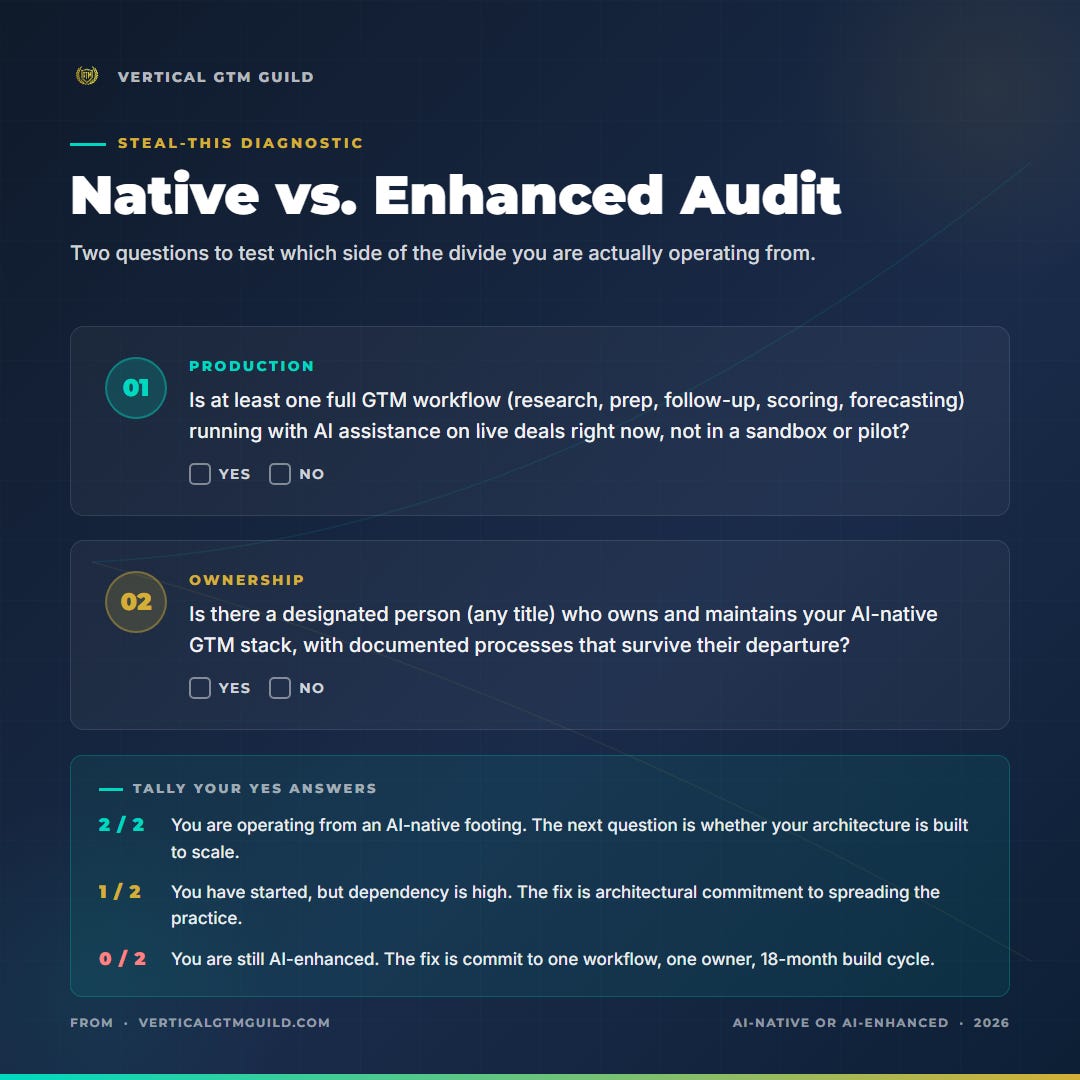
1. Production: Is at least one full GTM workflow (research, prep, follow-up, scoring, forecasting) running with AI assistance on live deals right now, not in a sandbox or a pilot?
2. Ownership: Is there a designated person (any title) who owns and maintains your AI-native GTM stack, with documented processes that survive their departure?
2/2: You are operating from an AI-native footing, at least in one workflow. The next question is whether your architecture is built to scale.
1/2: You have started, but the dependency on one person or one experiment is high. The risk is concentration. The fix is architectural commitment to spreading the practice.
0/2: You are still AI-enhanced. The fix is to commit to one workflow, one owner, and an 18-month build cycle starting this quarter.
Ryan Vanshur is the founder of the Vertical GTM Guild and Head of GTM Intelligence and AI Solutions at Handle.com. He co-founded CourseKey and scaled it from a $1,200 minimum viable product through a private equity exit over a decade in vocational education, building and rebuilding its GTM operating model along the way. He writes about AI-native go-to-market for vertical SaaS operators.
Join the Guild for more on vertical SaaS, AI-native GTM, and the systems that compound.