The Displacement Data Is In
Six months ago the AI-native divide was an argument. Now it has revenue numbers, funding rounds, and analyst forecasts attached. Here is the evidence, including the parts that are still missing.

The Renewal That Turned Into a Bake-Off
A legal operations director is holding two proposals. One is the renewal for the research platform her firm has used for five years. It’s familiar, integrated, and priced per attorney. The other is from a vertical AI vendor whose system does not offer her attorneys a better search box. It drafts the first pass of the work itself.
Five years ago that second proposal would not have made the meeting. Last year it would have been a curiosity pilot. This year it is the incumbent’s problem, because the buyer’s question has changed from “which tool helps my team work faster” to “which system actually completes the work.”
In January, that shift was a prediction. We looked at this in “AI-Native or AI-Enhanced,” and argued the divide would resolve within 24 months. We are now roughly a quarter of the way through that window. This is the honest check-in: what the evidence shows, what it does not show yet, and what an operator should do about the difference.

What Changed Since the Prediction
Three things moved from argument to observable fact.
The production systems became businesses. Vertical AI agents stopped being demos with waitlists and started publishing revenue numbers, which is the moment a market shift becomes measurable.
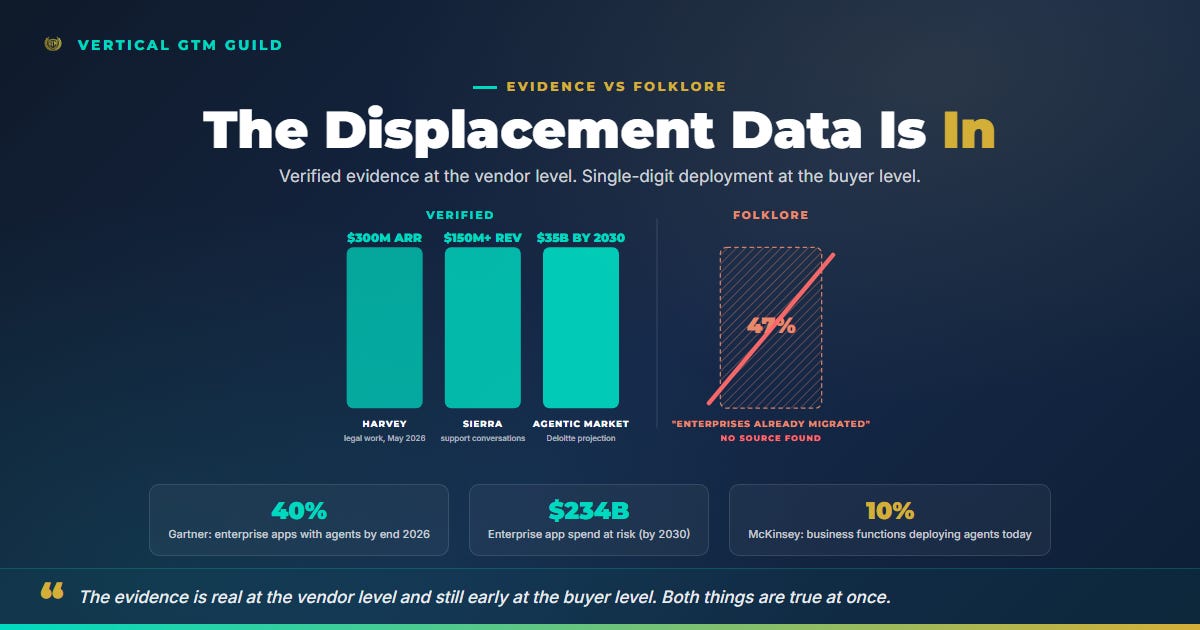
The analysts put dates on it. Gartner predicted in late 2025 that 40 percent of enterprise applications would feature task-specific AI agents by the end of 2026, up from under 5 percent in 2025. Whatever you think of analyst forecasts, an eight-fold curve in a single year is not a hedge. And in July, Gartner named the stakes: $234 billion in enterprise application spend at risk from agentic AI by 2030.
The money agreed. Deloitte’s 2026 predictions have roughly three-quarters of companies investing in agentic AI this year, with the agentic market growing from $8.5 billion to a projected $35 billion by 2030.
And the buyers changed their question. Twelve months ago, a vertical buyer evaluating AI asked for a demo and a security review, then piloted a copilot nobody used after week three. The proposals landing now get evaluated the way outsourced work gets evaluated. What is the error rate? Who checks the output? What does a unit of it cost? When procurement starts pricing your software like labor, the category has already moved, whatever the adoption surveys say.
Predictions age badly in this space, so hold them loosely. But the direction of every arrow is the same.
The Evidence We Actually Have
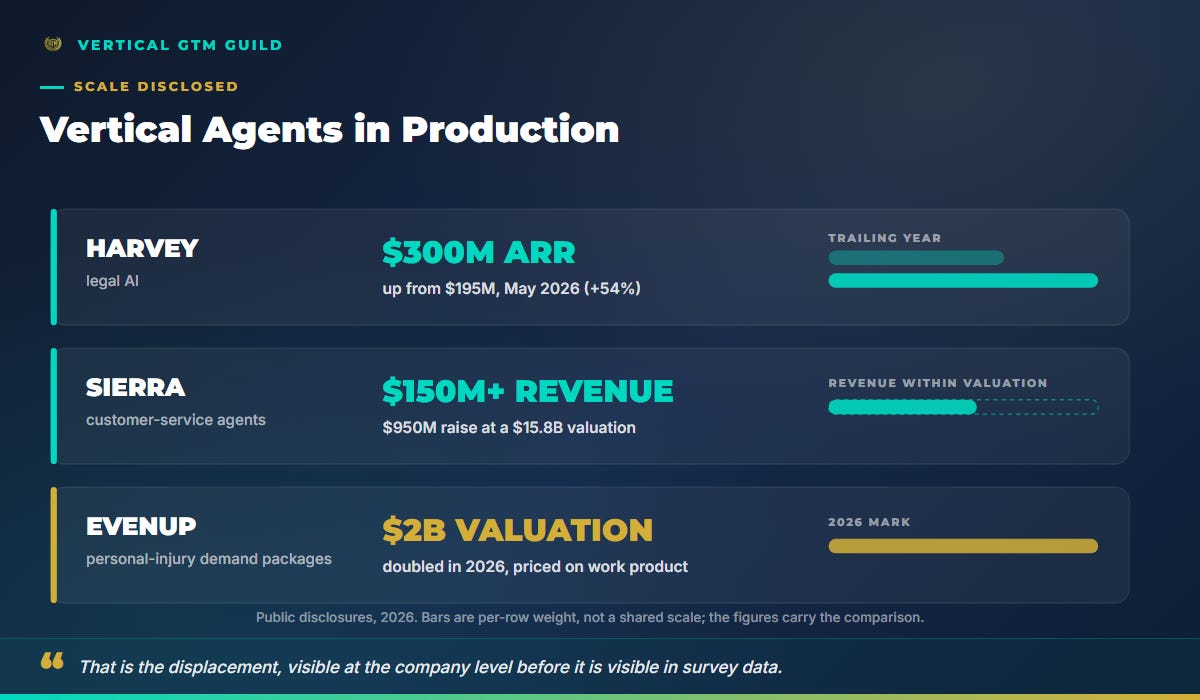
Start with what is publicly disclosed, because disclosed numbers are the closest thing this shift has to ground truth.
Harvey, the legal AI platform, reported scaling from $195 million to $300 million in annual recurring revenue by May, growth of roughly 54 percent in a stretch where most legal tech incumbents would celebrate a tenth of that. Law firms are not buying it as an experiment. They are buying it instead of hours.
Sierra, the customer-service agent company, raised $950 million at a $15.8 billion valuation with more than $150 million in annual revenue. Buyers are not paying that for a chatbot. They are paying for resolved conversations, priced closer to labor than to software.
EvenUp, which drafts personal-injury demand packages, doubled to a $2 billion valuation on the strength of work product, not seats. Hippocratic AI is running patient-facing care coordination in production health systems. Different verticals, same shape: the vendor sells completed work, and the market keeps writing bigger checks for it.
The funding market has made the same call. The rounds above are not spread across “SaaS with AI features” companies…they are concentrated in vendors whose product IS the completed work. A pitch that says “we added an assistant to our platform” now raises like a feature. A pitch that says “we deliver the finished demand package” raises like a category. Capital is a lagging indicator of buyer behavior, but it is not a stupid one.
Notice what these examples are not. They are not “we added AI to our product” press releases, of which there are thousands and which prove nothing. Each is a company whose entire commercial premise is that an agent completes work a person used to do inside a SaaS tool. That is the displacement, visible at the company level before it is visible in survey data.
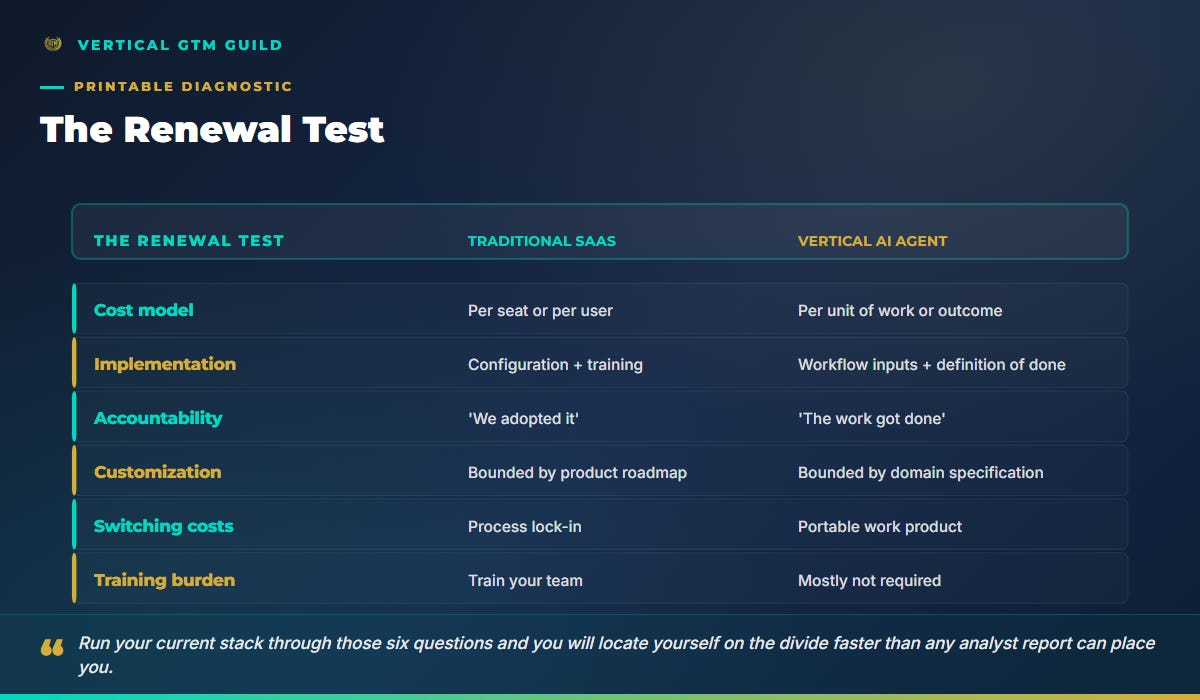
The Renewal Test
The cleanest way to feel the shift is to run the comparison a buyer runs at renewal time. Six factors, and the answers barely overlap.
Cost Model: the SaaS tool prices per seat or per user; the agent prices per unit of work or per outcome.
Implementation: the tool needs configuration and training; the agent needs your workflow’s inputs and a definition of done.
Accountability: with the tool, success means “we adopted it”; with the agent, success means “the work got done,” a sentence a CFO can audit.
Customization: the tool is bounded by a product roadmap; the agent is bounded by how well the domain’s work can be specified.
Switching Costs: the tool locks in your process; the agent’s output is work product, which is portable almost by definition.
Training Burden: the tool trains your team; the agent mostly does not need your team trained, which is precisely what unsettles the org chart.
Run your current stack through those six questions and you will locate yourself on the divide faster than any analyst report can place you. The full matrix is at the bottom of this piece, built to be printed and taken into your next renewal conversation.
The Gap in the Data, Honestly
Here is the part most coverage of this shift skips, and the reason this piece is an evidence review rather than a victory lap.
Comprehensive adoption data does not exist yet. McKinsey’s 2026 research finds only about 10 percent of enterprise business functions deploying AI agents today, and Stanford’s AI Index says agent deployment remains in the single digits across nearly all business functions. The displacement is real at the vendor level and still early at the buyer level. Both things are true at once.
Worse, the vacuum is filling with folklore. There is a statistic circulating in industry coverage claiming 47 percent of top-500 enterprises have already migrated a business process from SaaS to a vertical AI agent, attributed to Stanford. I went looking for it before writing this piece. It does not appear anywhere in the report it cites. If you have seen that number in a deck, it traces to nothing.
So here are three rules for reading vertical AI numbers this year, learned the tedious way.
Revenue Disclosures Beat Valuations. Harvey’s $300 million ARR says more than any multiple attached to it, because revenue is a buyer’s decision and a valuation is an investor’s.
Valuations Beat Anecdotes. Sierra’s $15.8 billion at least prices diligence someone performed.
Anecdotes Beat Nothing. But only barely, and only when the teller names the workflow. Any number that arrives without a population, a time period, and a source you can open does not go in your board deck.
That is the state of the evidence in month seven…real revenue at the vendors, real forecasts from the analysts, single-digit deployment at the median buyer, and a growing pile of unverifiable numbers in between. A market this early rewards operators who can tell the difference.
What This Means at Month Seven of Twenty-Four
If the divide resolves on anything like the predicted timeline, the operator reading this is not late. They are in the narrow stretch where the pattern is visible but the market has not yet repriced around it.
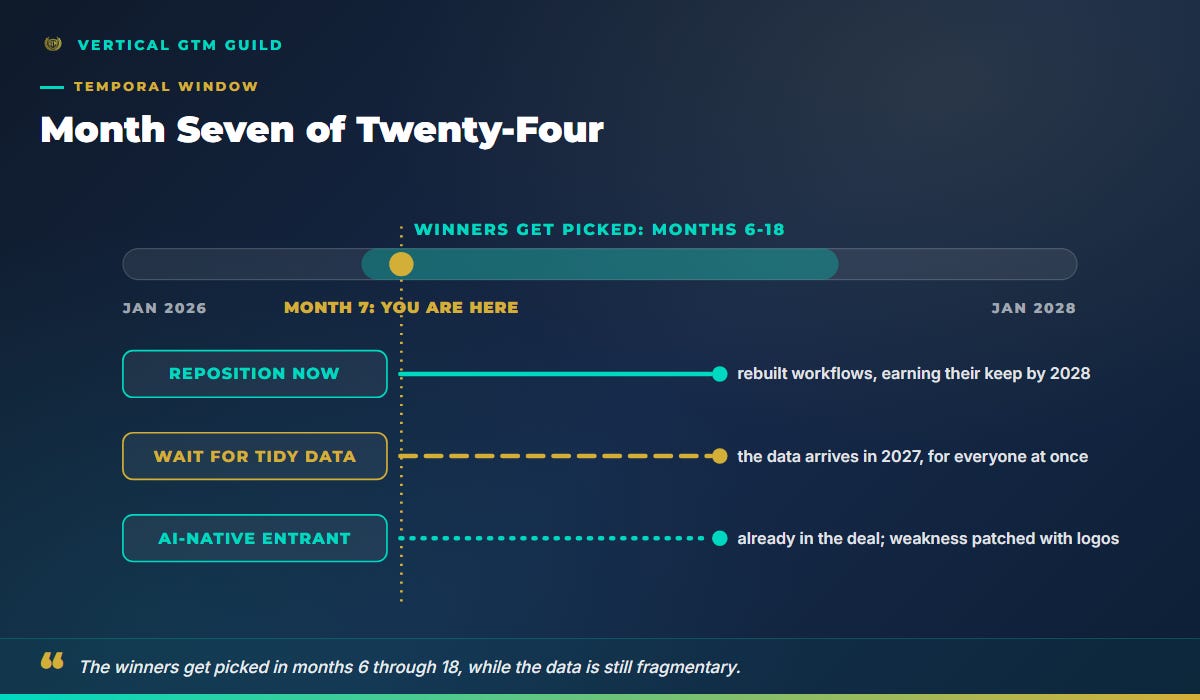
Three positions are available, and only one of them is chosen by default.
The repositioning incumbent starts rebuilding now…workflow by workflow, agent by agent, while their vertical depth is still a moat the AI-native entrants have not crossed. The evidence above is their tailwind, because the buyers reading Harvey and Sierra headlines are becoming easier to sell rebuilt architecture to. This position has a cost, and it is mostly internal. The operating model has to change before the market forces it, which means selling the redesign to your own team on fragmentary data. That is uncomfortable. It is also the entire advantage, because comfort is exactly what the window prices out.
The waiting incumbent wants tidier data before committing. The honest read of this article is that they will get it, sometime in 2027, at which point the same data will be available to their buyers, their board, and the AI-native entrant raising against their renewal base. Waiting does not preserve optionality. It transfers it, quietly, to whoever moved while the numbers were still messy.
The AI-native entrant is already in the deal. Ask the legal operations director holding two proposals. Their weakness is real…no standing in the vertical, no relationships, domain knowledge acquired at startup speed rather than earned over a decade. Every quarter an incumbent waits is a quarter that weakness gets patched with customer logos.
The uncomfortable math…the waiting position feels safest and is the only one that gets chosen without a decision. That is what “the divide resolves in 24 months” actually means operationally. Not that the losers get destroyed in month 25, but that the winners get picked in months 6 through 18, while the data is still fragmentary.
What Stays the Same
Honesty section, because displacement narratives always overreach.
Vertical depth matters more, not less. Every production system named above wins inside a narrow domain because the work is legible there: a demand package, a support resolution, a research memo. Domain knowledge is what makes the work countable, and counting the work is the whole business model.
The buyer relationship still decides. In SMB and mid-market verticals especially, trust travels through communities, and an agent vendor without standing in the vertical still loses to the incumbent who has it. The displacement evidence is strongest where the work is measurable and weakest where the relationship is the product.
And speed of deployment still beats model quality. Every vendor above runs on the same handful of foundation models available to their competitors, and to you. The differentiation is in the workflow capture, not the weights.
The Dinner in Eighteen Months
Picture an industry association dinner in early 2028, two operators from the same vertical at the same table.
One spent the window rebuilding…agents running the countable work, the team redesigned around judgment instead of throughput, pricing that quotes the work itself. She is not evangelizing at dinner. She is answering questions, because the operators around the table have started getting the same two proposals her buyers did.
The other spent the window shipping AI features and waiting for cleaner data. He got both…the features shipped, and the data arrived, in his competitors’ case studies. His renewal conversations now include a bake-off he did not schedule.
Nobody at the table says “AI-native” out loud. By then it is not a strategy. It is just the description of who is answering the questions and who is asking them.
The data is in, as much of it as month seven ever provides. The rest of the window belongs to whoever acts before the numbers get comfortable.
The Vertical GTM Guild is where vertical SaaS operators track shifts like this one with evidence instead of folklore, and build the response together.
If this was useful:
Join the Guild community and get the weekly operator brief: subscribe link in the first comment.
Steal the SaaS-vs-Agent comparison matrix below: it is the decision frame for your next renewal-versus-pilot choice.
Working through your own AI-native transition and want an operator in the room: link at the bottom of the page.